
Here’s a problem we often run into on electrical job sites: some cables list their cross-section using AWG, while others use Metric square millimeters. If this has ever left you scratching your head, you’re not alone. But here’s the thing – it’s just two different ways of measuring wire size. So how do you convert between AWG and Metric? In this article, we’ll break it all down for you.
1.Basic information about AWG and Metric
1.1 What is AWG
AWG, or American Wire Gauge, is the standard for wire sizes here in North America. Here’s the part that trips everyone up: the bigger the AWG number, the skinnier the wire. A smaller number actually means a fatter wire.
Why does it work backwards like that? It all comes from how they used to make wire back in the day. To size a wire, they’d pull it through a series of holes. The AWG number literally tells you how many holes it had to pass through. So, more holes meant the wire got stretched thinner and thinner.
1.2 What is Metric
Metric, measured in square millimeters (mm²), is the wire sizing system used pretty much everywhere except North America. Instead of a code like AWG, it just gives you the wire’s actual cross-sectional area. It’s a lot more straightforward.
The math is simple, basic geometry. For a round wire, you just use the formula S = πr². For a square or rectangular one, it’s simply length times width.
1.3 The difference between AWG and Metric
Even though both AWG and Metric measure wire size, they work in totally opposite ways. The first thing you’ll notice: with AWG, a bigger number means a thinner wire. But with Metric, bigger means bigger – it’s that simple.
They’re also used in different parts of the world. AWG is mostly used here in North America, while Metric is the go-to system pretty much everywhere else.
2. Why is it important to convert AWG to Metric?
Converting AWG to Metric isn’t just a math exercise – it’s about keeping your project safe, on track, and efficient. Here’s the lowdown:
2.1Unified standardization
A lot of cable is made in North America but used overseas. If the sizing systems don’t match, you can end up with wires that just don’t fit. Converting to Metric gets everyone on the same page.
2.2Accurate calculation
AWG is basically only used in the U.S. and Canada, while Metric is the global standard. Switching to Metric avoids costly mix-ups and miscalculations on the job site.
2.3Compliance and security
Using the wrong wire size is a major risk. At best, you get overheating; at worst, you’re looking at a fire. Sticking to one system – especially the one your local code requires – is your best bet for safety.
2.4Direct comparison and selection
The AWG scale isn’t linear. For example, the jump from 5 AWG to 10 AWG isn’t the same as from 15 AWG to 20 AWG. With Metric, what you see is what you get: a bigger number means a bigger wire, plain and simple.
2.5Facilitates procurement and supply chain
Outside North America, all the connectors and terminals are built to Metric specs. If you don’t convert your AWG sizes, good luck finding parts that fit. Getting your conversions right streamlines your whole supply chain.
3.AWG to Metric Conversion Method
Now, we will examine the process of converting AWG to Metric.
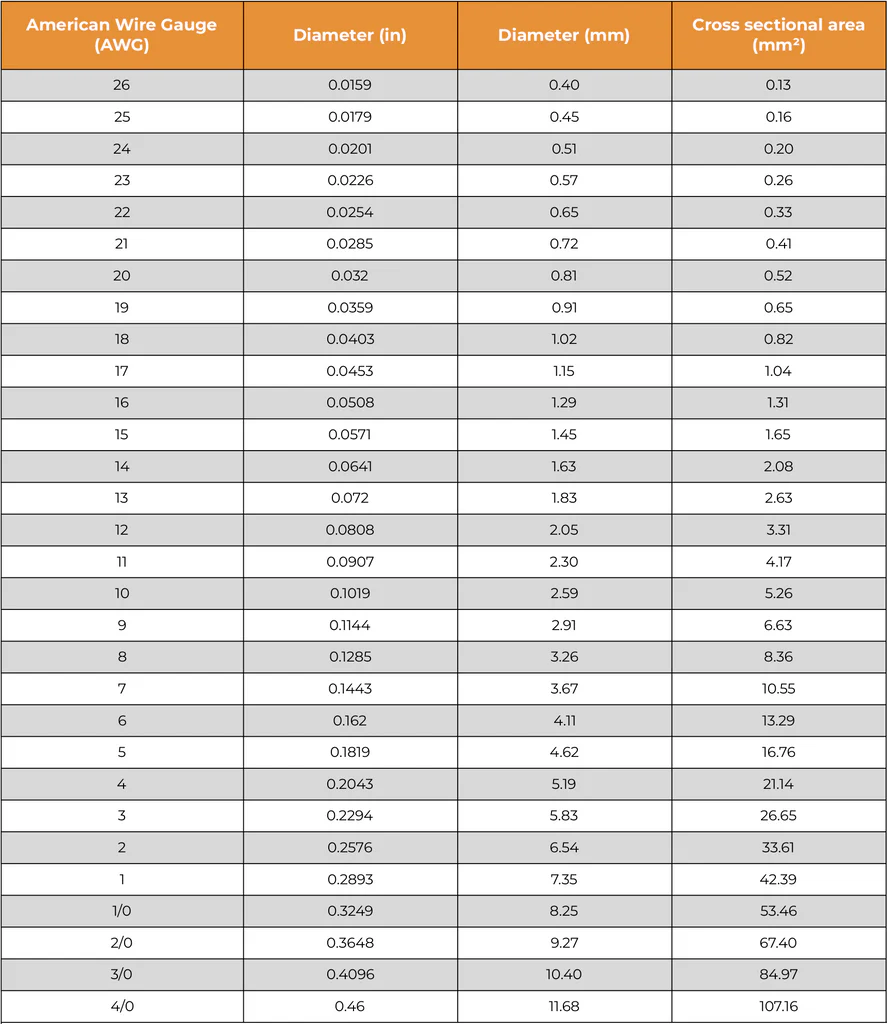
3.1AWG to Metric conversion table
3.2AWG to Metric Conversion Formula
There’s no simple algebra formula for converting AWG to square millimeters, but here’s a handy rule of thumb:
For every 3-gauge drop in AWG, the cross-sectional area roughly doubles. For every single gauge decrease, the metric diameter increases by about 1.122 times.
Here’s the actual formula used to convert AWG to metric diameter:
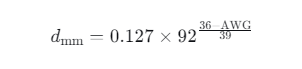
Where:
- d = diameter in millimeters
- AWG = American Wire Gauge number
- 0.127 = base diameter (for 36 AWG in mm)
- 92 & 39 = constants defined by the AWG standard
Let’s try it for 18 AWG:

That gives us 1.02 mm, which is pretty much right on with the standard value of 1.024 mm.
4.Common Mistakes
4.1 A Quick Heads-Up:
The numbers you see in conversion charts are for the bare conductor diameter – that’s without any insulation. If you need the total outside diameter, add twice the insulation thickness to that number.
4.2 Remember How AWG Works:
The AWG scale is backwards – a bigger gauge number means a thinner wire, not thicker.
5.Summary
To convert AWG to metric, just use the chart as your guide. When it’s time to pick the right metric cable size, match it up using the table.
We hope this makes your next AWG-to-metric conversion a smooth one.